Databricks Data + AI Summit 2026: What I Saw on the Floor, and What It Means for Enterprise Data Leaders
Summary
I am writing this from the floor at the Databricks Data + AI Summit 2026 in San Francisco, and the message here is hard to miss: generative AI has left the experiment phase. Nobody is asking whether to use it anymore. They are asking how to run it at scale, in production, without losing control of their data. That single shift explains almost every announcement Databricks made this week, and the through-line behind all of them is one idea: one governed platform for data, AI agents, BI, real-time apps, and operational workloads. For enterprise data leaders, the headline is not any single product. It is that the platform is now ready for agents, and the question has moved to whether your data foundation is.
Last Updated
Published
Authored By
Managing Partner
Reviewed By
Marketing Director

TL;DR
- The shift: GenAI is out of the lab. The conversation on the floor is entirely about running AI in production, governed, at scale.
- The theme: "one governed platform." Almost every announcement extends Unity Catalog governance to agents, models, and real-time workloads.
- The six that matter for enterprises: Unity AI Gateway, Unity Catalog upgrades (Glossary, Domains, Governance Hub), Agent Bricks as an agent platform, Genie One, security and compliance upgrades, and CustomerLake.
- The takeaway for leaders: the platform is ready for agentic AI. Whether you are ready depends on your data foundation, your governance, and, for European teams, your data residency model.
- Our read: the firms that win with this will not be the ones who adopt fastest. They will be the ones whose foundation was already governed and usable.
The conversation has changed
A year ago, the Summit floor was full of demos. Impressive, but demos. This year it is full of architecture discussions. The questions I am hearing from data leaders are not "can we build an agent." They are "how do we run a hundred agents in production without losing track of what they can see, what they cost, and what they are allowed to do."
Three things are catching our attention this week:
- Agentic AI is being treated as an architecture decision, not a demo. The serious conversations are about governance, evaluation, and cost, not party tricks.
- Unity Catalog and Lakeflow are maturing into the backbone of AI-ready platforms. Governance is no longer a side feature. It is the foundation everything else sits on.
- Legacy-to-lakehouse migration is being framed as a foundation problem, not a tooling problem. Which is exactly how we have always framed it.
That last point matters, because it is the difference between a project that ships and one that stalls at eighty percent. The powe

r of data only shows up when it is governed, secure, and actually usable. That has been our line for years. This week, it became the centre of Databricks' strategy.
The announcements that actually matter for enterprise data leaders
Databricks announced a lot. Here are the six that I think genuinely change the conversation for enterprise data and AI teams, with our honest read on each. We are publishing a deeper breakdown of each one, linked below.
1. Unity AI Gateway: governance for the AI runtime
This is the one I would not skip. Unity AI Gateway extends Unity Catalog governance to the runtime behaviour of AI systems: models, agents, MCP servers, tools, and external providers. Access controls, lineage, auditing, runtime policies, guardrails against PII leakage and prompt injection, tracing, and spend controls, all in one place.
Why it matters: most enterprises want agents and are quietly terrified of the security, cost, and governance risk. This is the answer to that fear. If you are putting agents into production, this is the control plane you build on. Read our deep dive on Unity AI Gateway.
2. Unity Catalog upgrades: Glossary, Domains, and Governance Hub
Databricks added a Business Glossary, Domains, cross-cloud and cross-region governance, and a Governance Hub to Unity Catalog. Domains are in Public Preview, Governance Hub in Private Preview.
Why it matters: this turns Unity Catalog from a technical catalog into the semantic control plane that both humans and agents read from. An agent is only as good as the business meaning it can be trusted with. This is how you give it that meaning, governed. Read our deep dive on Glossary, Domains and Governance Hub, or see our Unity Catalog guide.
3. Agent Bricks becomes a full agent platform
Agent Bricks grew from an agent-building tool into a developer platform for production agents: model choice, enterprise context, evaluation, monitoring, deployment, governance, and cost control. Databricks says more than 100,000 agents have been built on it, and that it now processes over a quadrillion tokens a year. It also added broad model support, including OpenAI, Anthropic, Gemini, Qwen, Kimi, and Grok natively.
Why it matters: the build-an-agent demo is over. This is about running agents in production, evaluated and governed, with the cost visible. That is an engineering and operating-model problem before it is a model problem. Read our deep dive on Agent Bricks.
4. Genie One, Genie Agents, and Genie Ontology
Genie One is positioned as a data-smart AI coworker for business users, with Genie Agents and a Genie Ontology underneath. Employees ask business questions, create outputs, and trigger actions using governed enterprise context, not raw tables.
Why it matters: this is Databricks going after the AI coworker category, but grounded in Unity Catalog, metrics, dashboards, and lineage. For a business leader that is the difference between an assistant that guesses and one that answers from your actual governed numbers. The catch, as always, is the ontology underneath. It is only as good as the semantic layer you give it. Read our Genie One deep dive.
5. Security and compliance upgrades
Automatic Identity Management for Microsoft Entra ID is now GA on AWS and GCP, AIM for Okta is in Public Preview, plus Context-Based Ingress policies, a Private Network Gateway, expanded Private Link for Lakebase, and broader cross-cloud compliance.
Why it matters: for our European clients this is not a footnote. Identity, network isolation, and residency are the difference between a platform your risk team approves and one they block. This is the unglamorous layer that decides whether regulated enterprises can actually adopt the rest. Read our security and compliance deep dive.
6. CustomerLake: an agentic CDP in the lakehouse
Databricks also entered marketing technology with CustomerLake, an agentic customer data platform built into the lakehouse: Customer 360, identity resolution, audience building, campaign automation, and activation, on governed data.
Why it matters: it puts Databricks directly into CDP territory with a simple pitch, your customer data already lives in the lakehouse. As with everything else this week, it only works on a governed, identity-resolved foundation. We wrote the full breakdown here: Databricks CustomerLake explained.
Also worth knowing (we are not covering these in depth, but they fill in the picture): Lakehouse//RT with the new Reyden engine for millisecond real-time queries, Lakebase and the LTAP direction unifying transactional and analytical workloads, an expanded Free Edition, and the acquisition of Panther Labs pushing Databricks deeper into security.
What this means if you are scaling data and AI
Step back from the product names and the strategy is clear. Databricks wants to be the single governed platform for data, AI agents, BI, real-time apps, operational workloads, and enterprise context. One place, governed by Unity Catalog.
For an enterprise data leader, that is genuinely good news and a genuine warning at the same time.
The good news: the platform is now mature enough to run agentic AI in production, with governance and cost control built in rather than bolted on.
The warning: every one of these capabilities assumes a foundation. Agents need governed, identity-resolved, semantically-defined data. Unity AI Gateway governs runtime behaviour, but it cannot fix an ungoverned catalog underneath it. Genie is only as smart as the ontology you give it. CustomerLake only works on a real Customer 360. Point any of this at a fragmented, ungoverned estate and you get fast, confident, wrong decisions at scale.
So the question this Summit really asks of you is not "which of these should we buy." It is "is our foundation governed, secure, and usable enough that we could safely turn these on." For most organisations, honestly, the answer today is not yet. And that gap is fixable.
The Cosmos Thrace take
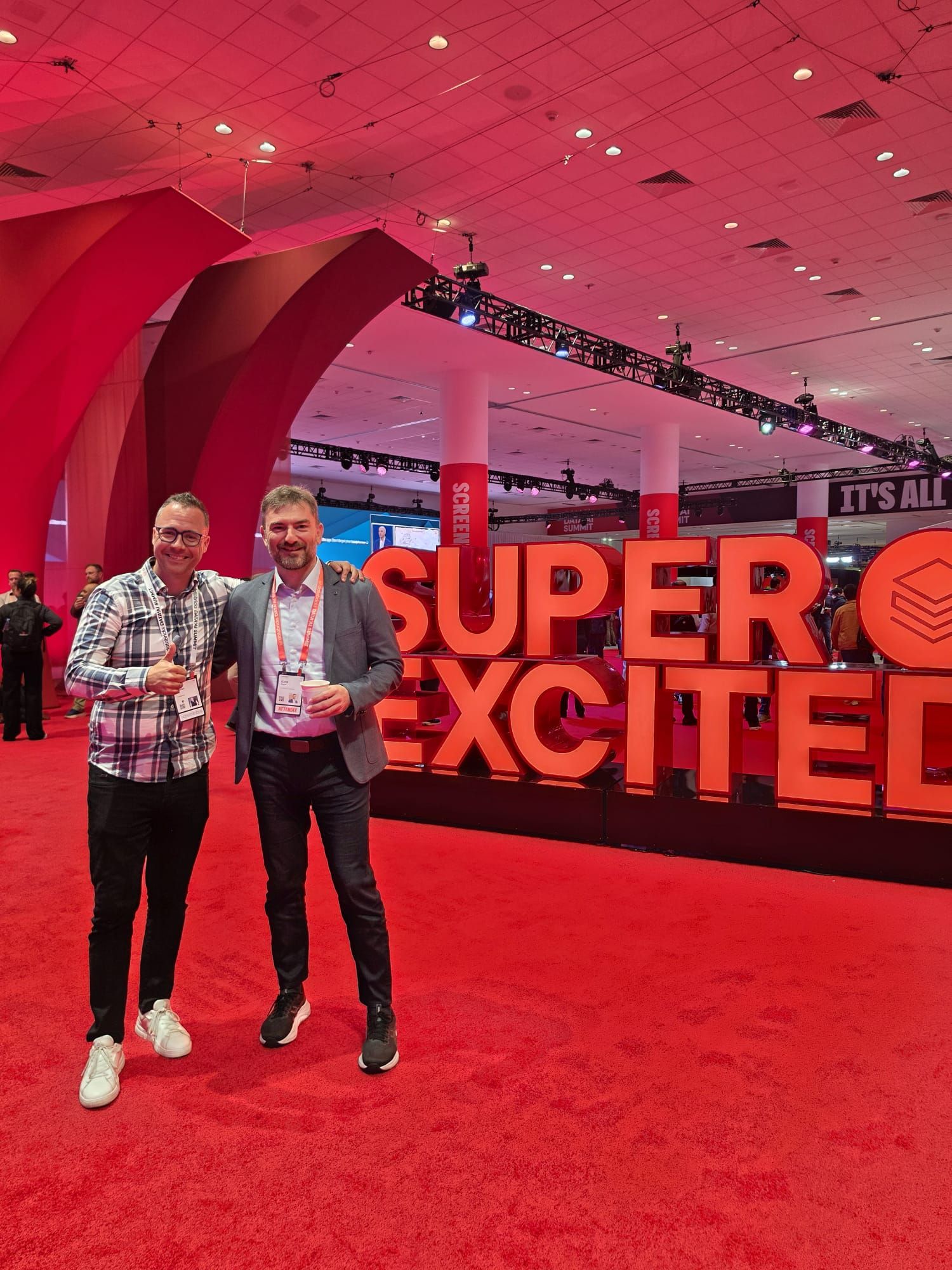
I am taking what works here back to our clients across Europe and North America. I also got to spend real time with Istvan Víz, who leads Databricks sales across Eastern EMEA, our home region, and the read from those conversations matches what we see in delivery: the appetite for agentic AI is enormous, and the blocker is almost never the model. It is the foundation.
That is the conversation we are built for. We are a Databricks Silver Partner, and our work is the layer underneath every announcement on this floor: getting the data foundation unified, governed, and trustworthy enough that the clever things on top actually work. We have delivered dozens of data platform implementations across Europe, many on Databricks, with more than $50M saved for clients in 2025, a 100% client retention rate, and 106 million data points moved daily.
Our honest prediction: the enterprises that win with everything announced this week will not be the ones who adopt fastest. They will be the ones whose foundation was already in shape. Governed in Unity Catalog. Identity resolved. Secure. For European teams, residency designed in. The platform moved toward agents. The teams that win get the foundation right before the agents arrive.
If you were at the Summit too, let us talk. And if you are wrestling with how to scale your data and AI stack without the foundation cracking, that is exactly the conversation we are built for.
Sources
Coverage and announcements from the Databricks Data + AI Summit 2026 (Databricks newsroom and blog). Individual deep-dive articles in this series cite the specific press release for each announcement.
Cosmos Thrace deep dive: Databricks CustomerLake explained
Book a 30-minute Databricks readiness review with one of our senior engineers. No pitch deck. We'll look at where you are, where you want to be, and the fastest path between the two.

What people ask about Databricks Summit 2026
The most significant for enterprises were Unity AI Gateway (governance for AI runtime), Unity Catalog upgrades (Business Glossary, Domains, Governance Hub), Agent Bricks becoming a full production-agent platform, Genie One (a data-smart AI coworker), security and compliance upgrades, and CustomerLake (an agentic CDP). The unifying theme is one governed platform for data, AI, and agents.
It is the idea that data, AI agents, BI, real-time applications, operational workloads, and enterprise context should all run on a single platform governed by Unity Catalog, rather than across separate, disconnected systems. Almost every 2026 announcement extends that governed platform to a new area.
Yes, decisively. Agent Bricks is now a full platform for building, evaluating, governing, and running production agents, Genie One is an agent-based AI coworker, and Unity AI Gateway governs agent runtime behaviour. Databricks reports more than 100,000 agents already built on the platform.
The platform is ready for agentic AI, but adoption depends on governance and data residency. The security and compliance upgrades (Entra ID identity management, Private Link, network isolation) and Unity Catalog's cross-region governance are what make regulated European adoption possible. The foundation work, governance and residency designed in, is the prerequisite.
Start with the foundation: unify and govern customer and operational data in Unity Catalog, resolve identity, define business meaning (glossary, domains, ontology), and design security and residency in from the start. Agents amplify whatever foundation they sit on, good or bad.
Book a 30-minute Databricks readiness review with one of our senior engineers. No pitch deck. We'll look at where you are, where you want to be, and the fastest path between the two.