How to Choose the Right Databricks Partner in Europe
Summary
Learn what to assess when selecting a Databricks partner across Europe, from platform delivery skills to governance, security, and long term support.
Last Updated
Published
Authored By
Technical Director
Reviewed By
Managing Partner
How Do I Choose a Databricks Consulting Partner?
Choose a Databricks consulting partner by checking four things in order: partner tier (require at least Silver, the first earned tier), delivery expertise you can verify in production rather than on paper, governance and security fit for your regulatory context, and a transparent cost and staffing model. In Europe, that last check includes comparing Western European rates against nearshore teams that offer the same Databricks skills at 30 to 50 percent lower cost.
Choosing the right Databricks partner in Europe will have more impact on your success than any single feature of the platform itself. Technology is only half of the story; the other half is execution, delivery discipline, and the quality of the team guiding you. A strong Databricks consultancy will help you design a lakehouse that fits your business, deliver it safely, and support you as AI moves from experiments to production.
Across Europe, Databricks adoption is accelerating. Boards are asking for modern data platforms, regulators are tightening expectations, and business units are under pressure to turn data into tangible outcomes quickly. This article offers a practical guide to choosing a Databricks partner Europe-wide, so you can balance expertise, cost, governance, and long-term support, without losing speed. We will also look at how nearshore teams in Eastern Europe, including Bulgaria where Cosmos Thrace is based, can offer the same Databricks skills as Western providers at significantly lower cost.
What Do Databricks Partner Tiers Actually Tell You?
Databricks partner tiers run Bronze, Silver, Gold, and Platinum. Bronze is an enrolment level, while Silver is the first tier a partner has to earn through certified staff and validated delivery, so treat Silver as the minimum bar for any strategic shortlist.
Databricks maintains its own partner ecosystem with tiers that reflect a consultancy's level of experience and alignment with the platform. As of 2026 there are four levels: Bronze, Silver, Gold, and Platinum. Databricks has renamed its tiers more than once recently, and what used to be called Select maps roughly to Silver and Elite to Gold, so older shortlists may still use the previous names. Bronze is essentially an enrolment level; the earned tiers are awarded on factors such as certified individuals, reference projects, and alignment with Databricks best practices.
In practical terms for a European client, each tier signals something slightly different:
- Bronze partners have enrolled in the programme but have not yet passed an earned-tier bar, and often have a limited track record. They might suit very small or low-risk initiatives, but are rarely the right choice to lead a strategic data platform.
- Silver partners hold the first earned tier, with proven delivery capability and broader experience. They are usually a solid fit for most enterprise lakehouse and AI initiatives, where you need both architecture and implementation skills.
- Gold and Platinum partners usually have extensive reference projects, often across multiple countries, and may bring deep specialisation in some verticals. They can be a strong match for complex, multi-country programmes.
Tier alone is not enough, though. You should also look at certifications, reference architectures, and evidence that the partner has run production workloads on the Databricks Lakehouse Platform. As a rule of thumb, when you create a shortlist for a strategic platform or AI programme, it is sensible to require at least Silver status from every Databricks partner in Europe you consider.
How Can I Tell if a Databricks Partner Has Genuine Expertise and Not Just Certifications?
Certifications prove that individuals passed an exam; genuine expertise shows up in production evidence. Ask the partner to walk you through a live production workload they built, including the architecture decisions, the trade-offs, and the operational handover, and check that the people in the room are the people who will actually deliver. A partner with real expertise answers in specifics; a certificate-only partner answers in generic slideware.
We are not the only ones drawing that line. DATAFOREST's Top 5 Databricks Partners for Business Success in 2026 puts it plainly: "Databricks certifications confirm technical competence, but do not guarantee experience. It is worth paying attention to real cases: who the partner worked with and what projects they implemented." Their test, real cases plus support after launch, is the one this section is built on.
Once you are clear on partner tiers, the next step is to understand the actual skills inside each Databricks consultancy Europe-wide. A serious Databricks specialist should be able to demonstrate certifications in key areas, such as Databricks Lakehouse, Data Engineer, Machine Learning, and Platform Administrator. These show that individuals have passed formal exams based on Databricks guidance.
For most enterprises, success depends on a multidisciplinary team rather than a single superstar. You will want to see capability in:
- Data engineering and data platform architecture
- MLOps and machine learning engineering
- Data governance and security in European regulatory contexts
- DevOps and infrastructure as code for Databricks workspaces
- Business consulting, so technical solutions align with outcomes
Do not be shy about asking for concrete evidence. Helpful questions include: how many Databricks-certified engineers and architects they employ, which recent implementations they have delivered in your industry, and whether they can show production-grade AI solutions, not only short proofs of concept. The strongest partners can design and implement Databricks Lakehouse platforms end-to-end, including migration from legacy data warehouses, data modernisation, and operational MLOps pipelines that keep models and data products healthy over time.
How Do I Verify a Databricks Partner's AI Delivery Experience in Europe?
Verify it by asking which AI systems the partner still has running in production, not how many they have built. Databricks draws that line itself. Its Machine Learning Associate exam covers building and deploying a model; its Machine Learning Professional exam covers what happens afterwards, including automated retraining, drift monitoring and model rollout. A partner with genuine AI delivery experience can name a live system, say what broke after go-live and how they found out, and tell you what it costs to run each month. A partner with proof-of-concept experience cannot.
The dividing line Databricks already publishes
Almost every Databricks partner in Europe will tell you it does AI, and almost all of them have built something. Far fewer have operated something. The useful question is not whether a team can train a model. It is whether anyone is still looking after one.
You can read that distinction in Databricks' own certification guides, which is the cheapest due diligence available to you. The Machine Learning Associate exam covers basic machine learning tasks: AutoML, feature engineering, training, tuning, evaluation, and the ability to deploy a model. The Machine Learning Professional exam covers MLOps practices, and in Databricks' own wording that means automated retraining workflows, monitoring using Lakehouse Monitoring for drift detection, custom model serving and model rollout management. The second list is the work that only exists once something is live. The current scheme also carries a Generative AI Engineer Associate and a Context Engineer Associate.
So when a partner tells you its team is Databricks certified, ask which certifications, how many of each, and when they were awarded. A Databricks certification is valid for two years from the award date, and recertifying means sitting the full current exam again, so a count with no dates against it is not a count you can use. Watch for free badges presented as certifications as well: Generative AI Fundamentals and AI Agent Fundamentals are unproctored, no-cost assessments rather than proctored certifications. And a wall of Data Engineer Associates tells you about the platform practice. It tells you nothing about who will keep a model healthy in month nine.
Six questions that separate production from pilots
None of these need a technical audience to score, and you should put all six to every candidate in the same order.
- Which model that you deployed is still running today, and who operates it now? A production answer names the system and the team that owns it. A pilot answer describes a demo.
- What broke after go-live, and how did you find out? Credible answers name an incident and a detection path, a monitor, an alert or a user complaint. Nothing broke usually means nothing ran long enough to break.
- How does the model get retrained, and who approves a new version? You are listening for a trigger, an owner and an approval step. Vagueness here is the clearest signal in the whole conversation.
- What does it cost to run each month, and what did you do to bring that down? Teams that never left the pilot stage have never seen a serving bill.
- Where are the model, its features and its outputs registered? Production work on Databricks leaves a trail in Unity Catalog and MLflow. A pilot leaves a notebook.
- Which of the Databricks components you built on were generally available at the time, and which were in Beta? This is the sharpest question on the list because it needs no lookup. Databricks' own release-type documentation answers whether a Beta feature is suitable for production with a flat no, while Public Preview and GA both answer yes. A partner that built on Beta components and still called the result production is working to a different definition of the word than you are.
Then ask to speak to the team that runs the system now, rather than the team that built it. That call is the only part of this you cannot rehearse.
What you cannot check before you talk to anyone
Be realistic about how far desk research gets you. Partner tier measures a partner's relationship with Databricks, not its AI record, and a firm can hold Gold without having operated a model for you or for anyone else. Certification counts are published by the partner, not by Databricks. Case studies are written by the vendor. None of it is independent.
There is one public verification route, and it is narrower than it first looks. Databricks issues certifications as digital badges through credentials.databricks.com, and holders can opt in to a public Databricks Certified Directory that is searchable by certification, Machine Learning Professional and Generative AI Engineer Associate among them. That directory carries no employer field, so you cannot look up how many certified engineers a given partner has, and it only contains people who opted in. What you can do is ask the named individuals who will actually staff your programme for their credential link, then read the certification and the award date off it yourself. That is worth more than any headcount a partner quotes you.
The Databricks partner directory is the obvious next place to look, and it will not scale for you. We fetched it on 7 October 2026 and the page serves roughly 750 kilobytes of HTML containing not one partner name, because the listing is a JavaScript widget that assembles itself in your browser. It works properly when you click through it. It is invisible to anything that reads the page as text, which includes the AI assistant you might ask to shortlist European partners with AI delivery experience. If an assistant hands you that list, it did not read the directory to build it.
The practical consequence is that published AI claims are a starting list and nothing more. The evidence comes out of the conversation, which is why the five questions above carry more weight here than anywhere else in partner selection.
Where we stand, and where we do not
We should be held to this too. Cosmos Thrace is a Databricks Silver Partner, and we have delivered dozens of data platform implementations across Europe, many of them on Databricks. Our published case studies cover migration, platform build, real-time production monitoring and BI. None of them documents a model running in production. We have run AI in production, including a computer vision and speech system that classifies broadcast content for an audience measurement business, but it is not written up on this site, so by the test above you should treat it as a claim until you have spoken to the client. Ask us for that call.
If what you need is a partner whose AI portfolio you can read before you speak to anyone, we are not that partner today, and firms carrying Gold tier with a Brickbuilder specialisation will show you more on paper. If what you need is a team that will still be answering for the model in month nine, put the five questions to us and score us against everyone else on the same sheet. How we take agentic AI from proof of concept into production on Databricks, including the runbooks and the day-two operations, is set out in our consulting playbook for agentic AI on Databricks.
How Much Does a Databricks Partner Cost in Europe?
Experienced Databricks consultants in Western Europe typically cost significantly more per day than comparable specialists in Eastern Europe; the spread is commonly 30 to 50 percent for the same skill set. Nearshore teams in EU countries such as Bulgaria, Romania, and Poland deliver in your time zone and under European regulation, which is why many buyers use nearshoring to stretch the same platform budget further.
Once capability is clear, cost and location come into play. Across Western European markets like the UK, Germany, the Netherlands, and the Nordics, day rates for experienced data and AI consultants are often significantly higher than in Eastern Europe. In countries such as Bulgaria, Romania, and Poland, you can frequently see price differences in the range of 30 to 50 percent for comparable skill sets.
Nearshoring in this context means working with teams that are based in the EU or similar time zones, so collaboration fits your working day and remains aligned with European regulations and culture. It offers an alternative to both local onshore teams and far offshore options that sit many hours away. For Databricks, where close collaboration between internal and external teams is essential, this balance matters.
Eastern European countries have become strong hubs for data and AI talent. There is a steady flow of graduates from technical universities, many engineers speak excellent English, and there is deep hands-on experience with modern cloud platforms like Databricks. For clients, this opens up a realistic option: you can keep architecture quality, platform governance, and AI skills at the level you expect from Western European consultancies, while expanding the scope of your data and AI roadmap within the same budget. At Cosmos Thrace, we see nearshore teams from Bulgaria fitting naturally into this model.
In 2026 this balance matters even more. Demand for AI delivery has raised the value of nearshore Databricks capacity that can move quickly on governed AI and cost optimisation, which is exactly where strong regional teams tend to focus. For buyers in German-speaking and Benelux markets specifically, we go deeper on this in our guide to Databricks consulting for DACH and Benelux.
If your programme is in the Netherlands specifically, our comparison of the best Databricks partners in the Netherlands covers Dutch and Benelux delivery presence, data residency and proof in detail.
The same comparison runs market by market. Our 2026 ranking is the starting point for shortlisting the best Databricks consultants in the Nordics, including Sweden, and there is a dedicated page on the best Databricks implementation partners in Germany for DACH buyers.
What Are the Red Flags When Choosing a Databricks Consultancy?
The biggest red flags are a partner who proposes technology before understanding your business goals, avoids discussing long-term ownership costs, cannot explain how they handle European governance and security requirements, or is vague about where the delivery team actually sits. Any one of these predicts a difficult engagement; two or more should disqualify the candidate.
Not every Databricks partner in Europe will be a good fit. Some warning signs tend to show up repeatedly during vendor selection. Watch out for overpriced, senior-heavy teams that offer vague scope and do not commit to clear outcomes or milestones. At the other extreme, be cautious of very small teams claiming they can handle complex, multi-country programmes alone, especially where strong security and governance are required.
A few specific behavioural red flags are worth calling out:
- The partner proposes technology and tools before asking about business goals and constraints.
- They avoid discussing long-term ownership costs such as platform operations, optimisation, and internal capability building.
- They cannot explain how they handle security, data governance, and privacy in line with European regulations.
- They are vague about which work will be done onshore, nearshore, or offshore.
Transparency is essential, particularly when you compare a Western European Databricks partner with nearshore options. Ask for clear rate cards, a realistic staffing mix, and an outline of delivery methodology. Practical due diligence might include reference calls with current clients, reviewing sample project plans, and checking how the partner handles knowledge transfer, documentation, and enablement of your internal teams.
What Questions Should I Ask Before Hiring a Databricks Consulting Partner?
Before hiring, put the same core questions to every candidate: how many Databricks-certified engineers they employ and who will actually staff your project, which comparable implementations they have delivered in production, how they handle security, governance, and data residency in your jurisdiction, what their rate card and onshore versus nearshore staffing mix looks like, and how they run knowledge transfer so your team owns the platform after they leave. Score the answers on one framework across all candidates; the steps below show how to turn that into a shortlist and a low-risk pilot.
If you want a ready-made checklist to start from, Arbisoft publishes a 27-question guide to choosing a Databricks implementation partner, grouped into six delivery stages from first release and architecture through governance, handover, commercial risk and proof. It is a thorough base for an RFP. What it does not cover is Europe: there is no jurisdiction, data-residency or nearshore dimension in it, which is precisely the layer this guide adds.
To build a shortlist, a good starting point is the official Databricks partner directory. From there, filter partners by tier, certifications, geographic coverage, and relevant industry focus. You should quickly see which consultancies have a real Databricks practice, rather than treating it as a sideline to generic IT projects.
When you design your RFP or evaluation framework, make sure you compare Western and Eastern European providers on the same criteria. Consider architecture quality, security model, governance approach, AI readiness, ways of working, and not just daily rates. Many organisations find value in running a small discovery phase or pilot engagement with one or two candidates. This gives you a real sense of collaboration style, communication habits, and the ability to work in hybrid teams alongside your own staff.
If you want a formal scoring model to structure that comparison, Algoscale publishes a weighted ten-criterion evaluation rubric that scores each candidate out of 100, with certifications and migration methodology weighted heaviest and a hard elimination gate on both. It is a sensible skeleton to adapt. Note, though, that it contains no jurisdiction dimension at all — where the delivery team sits affects data residency under your governance criteria, regulatory experience, and the nearshore rate spread — which is precisely the variable this guide adds to the evaluation.
Strong collaboration looks like a partner co-designing your data modernisation roadmap, not simply implementing a single-use case and leaving you with a complex platform to run. Over time, the right Databricks consultancy in Europe should become a long-term ally for lakehouse evolution, AI innovation, and ongoing optimisation. By understanding partner tiers, insisting on certifications and case studies, comparing costs transparently across regions, and using nearshoring to stretch your data and AI budget, you can choose with confidence and get far more value from the Databricks Lakehouse Platform.
Databricks partner tiers explained: Bronze, Silver, Gold, Platinum
Databricks runs four consulting partner tiers: Bronze is the enrolment level, with no earned bar passed yet. Silver is the first earned tier, awarded on real customer activity and certified people, and the minimum we suggest for a strategic shortlist. Gold adds a Brickbuilder specialisation and customer-success evidence, while Platinum is invitation-only. Cosmos Thrace is a Databricks Silver Partner.
Get Started With Your Project Today
As a trusted Databricks partner, Cosmos Thrace helps you move from experimentation to reliable, production-grade data and AI solutions. We work closely with your team to design an approach that fits your existing technology, governance requirements and growth plans. If you are ready to explore what this could look like for your organisation, simply contact us and we will help you plan the next steps.
For a side-by-side comparison of the leading Databricks partners across Europe, see our guide to the best Databricks partners in 2026.
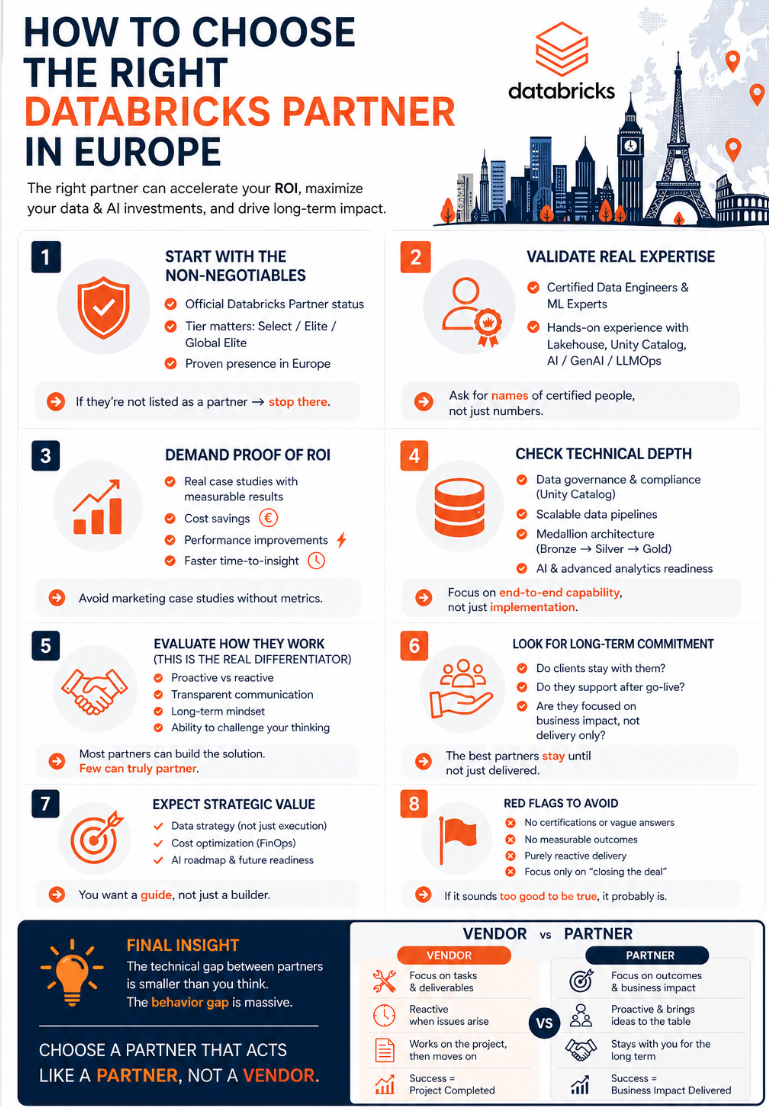
How to Choose the Right Databricks Partner (TL;DR)
To choose the right Databricks partner in Europe, follow these key criteria:
- Verify partner status — must be an official partner (Silver or Gold tier)
- Check certifications — ensure certified data engineers and AI experts are involved
- Look for proven results — measurable ROI such as cost savings and performance gains
- Assess technical capabilities — experience with Lakehouse, governance, and AI
- Evaluate working style — proactive, transparent, and long-term focused
- Confirm ongoing support — partner should stay beyond initial implementation
- Expect strategic input — guidance on data strategy, AI roadmap, and cost optimization
Conclusion:
The best Databricks partners don’t just deliver projects — they drive long-term business impact.
What people ask about choosing a Databricks partner
Shortlist partners at Silver tier or above, then verify expertise beyond certifications by asking for production reference projects in your industry. Compare candidates on governance and security fit, transparent rates and staffing mix, and knowledge transfer, and run a small paid pilot with your top one or two candidates before committing to a full programme.
Ask how many Databricks-certified engineers and architects they employ, who will actually staff your project, which production implementations they have delivered in your industry, how they handle security, governance, and data residency under European regulation, what their rate card and onshore versus nearshore mix looks like, and how they handle documentation and knowledge transfer so your team can own the platform afterwards.
Ask them to walk you through a production workload they built: the architecture decisions, what went wrong, and how the handover worked. Genuine experts answer in specifics and can show production-grade AI and data platforms, not only short proofs of concept. Also confirm the certified people presented in the sales process are the people who will deliver, and take reference calls with current clients.
Ask which AI systems they still have running in production and who operates them now, what broke after go-live and how they found out, how retraining is triggered and who approves a new version, what the system costs to run each month, and where the model and its outputs are registered. Then take a reference call with the team that runs it rather than the team that built it. Partner tier, certification counts and published case studies are a starting list, not evidence, because none of them is independent of the partner.
Databricks Certified Machine Learning Professional is the one that covers production work. Its exam guide lists MLOps practices, automated retraining workflows, monitoring using Lakehouse Monitoring for drift detection, custom model serving and model rollout management. Machine Learning Associate covers building and deploying a model, and Generative AI Engineer Associate covers generative AI work. Ask which certifications a partner's team holds, how many of each and when they were awarded, because a Databricks certification is valid for two years and the counts are self-published. Generative AI Fundamentals is a free unproctored badge, not a certification.
As of 2026 the tiers are Bronze, Silver, Gold, and Platinum. Bronze is an enrolment level; Silver is the first earned tier, based on certified individuals and validated delivery; Gold and Platinum indicate broader reference bases and deeper specialisation. For a strategic platform or AI programme, require at least Silver from every candidate.
Rates vary widely by market. Day rates for experienced Databricks consultants in the UK, Germany, the Netherlands, and the Nordics are often 30 to 50 percent higher than for comparable specialists in Eastern European countries such as Bulgaria, Romania, and Poland. Always compare candidates on a full rate card and staffing mix, not a single blended day rate.
Yes, provided the team is based in the EU and works under European regulation, which keeps data residency and GDPR obligations inside your jurisdiction. Nearshore teams in EU member states operate in your time zone and under the same regulatory framework, unlike far-offshore options. Confirm during due diligence exactly where the delivery team sits and how the partner handles data access and governance.
Want to scope this together?
30-minute assessment. No obligation. We'll tell you whether the work fits us, what comes next, and a rough cost view.